
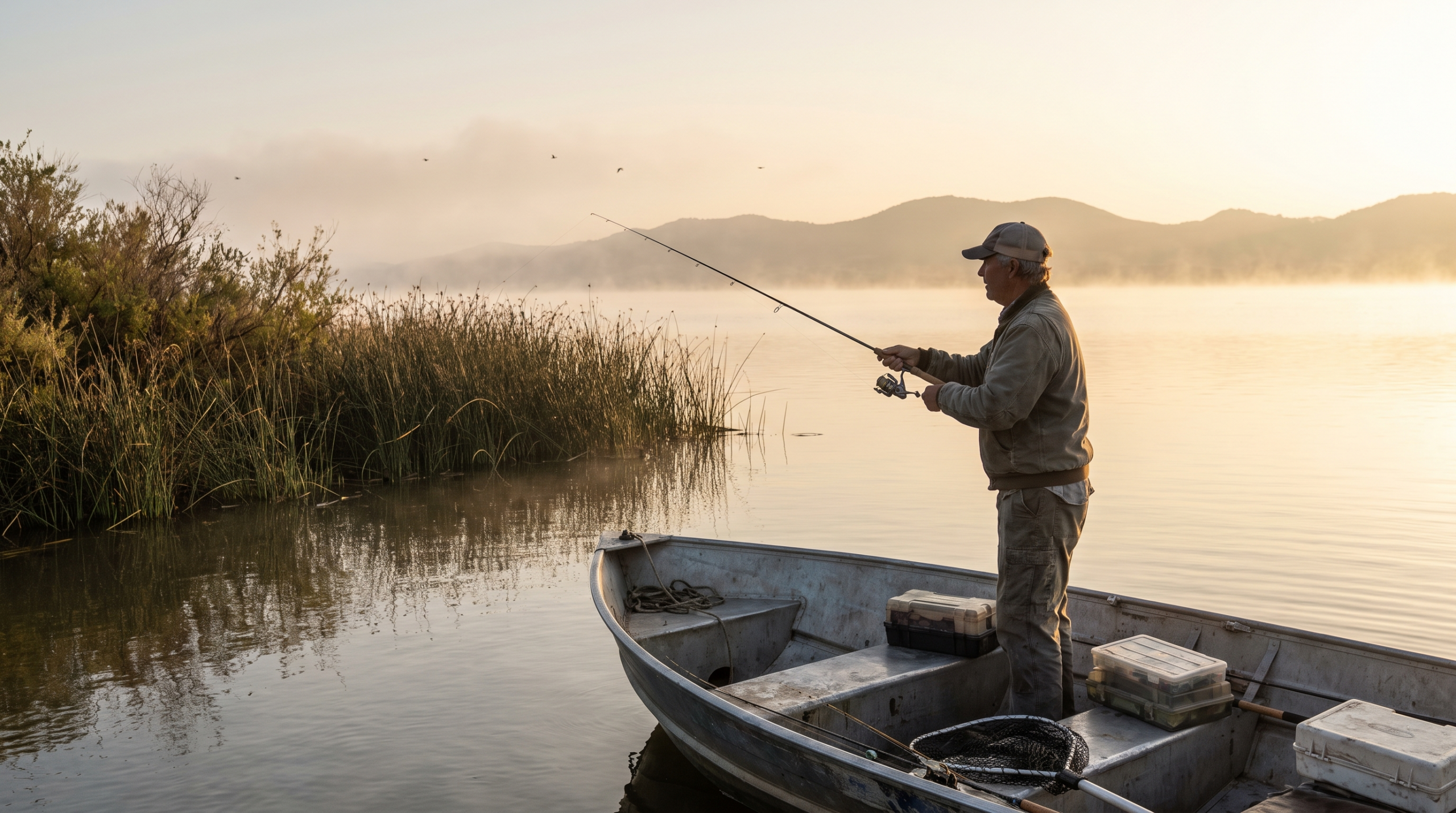
Clear Lake can make a simple bass-fishing decision feel complicated. A shoreline may offer tules, docks, rock, shade, bait, and several lure choices at once. The answer is not to carry more tackle. It is to make the decisions in the right order: find a productive area, identify what holds fish there, notice what bass may be eating, and only then choose a presentation.
Start With Largemouth and Start With Location
Clear Lake is especially relevant to largemouth bass anglers. Largemouth are built to use edges and ambush cover: a clean grass line, the shadow beside a dock, the outside face of tules, a piece of wood, or a break where shallow water falls away. That does not mean every attractive object holds a fish. It means the lake gives you many places to test a repeatable idea.
The most useful lesson from the source video is also the easiest to forget: location comes before lure. A beautifully colored bait cannot help if it never passes a bass. By contrast, several different lures may work when you find an area that combines usable habitat, nearby food, and a travel edge.
Begin by eliminating water. Look for combinations rather than isolated features. A tule edge becomes more interesting when it meets a depth change. A dock becomes more interesting when shade, vegetation, and visible bait overlap. A point becomes more interesting when wind pushes water across it or when fish can move quickly between feeding water and a safer depth.
If you need a visual starting point, use the Bass Probability Map as a planning tool, then make your own observations on arrival. A map narrows the search; it does not replace what your eyes, electronics, lure, and bites tell you.
Use Seasonal Movement as a Framework, Not a Calendar Promise
Bass move through recurring seasonal needs: suitable spawning areas, recovery and feeding water, summer habitat, fall forage, and winter security. The exact timing is controlled by local conditions, not by a date printed on a chart. At Clear Lake, think in terms of routes between protected shallows, feeding flats and edges, and nearby deeper or more stable water.
Before the spawn, fish often use staging cover or breaks near protected spawning water. During the spawning period, protected areas with suitable bottom or firm objects can matter. Handle bedding fish responsibly and follow current regulations. Afterward, many bass recover near cover and forage before spreading toward summer positions. In fall, scattered bait can make the search feel broad again. In colder periods, the best clue may be access to relatively deeper, more stable water—“deep” being relative to the area, not a universal number.
The practical move is to draw a route instead of naming a magic spot. Ask where a bass could spawn, where it could pause, where it could feed, and where it could retreat. Then fish the intersections. This keeps the seasonal framework useful even when conditions do not match the textbook.
Structure Is the Shape; Cover Is the Object
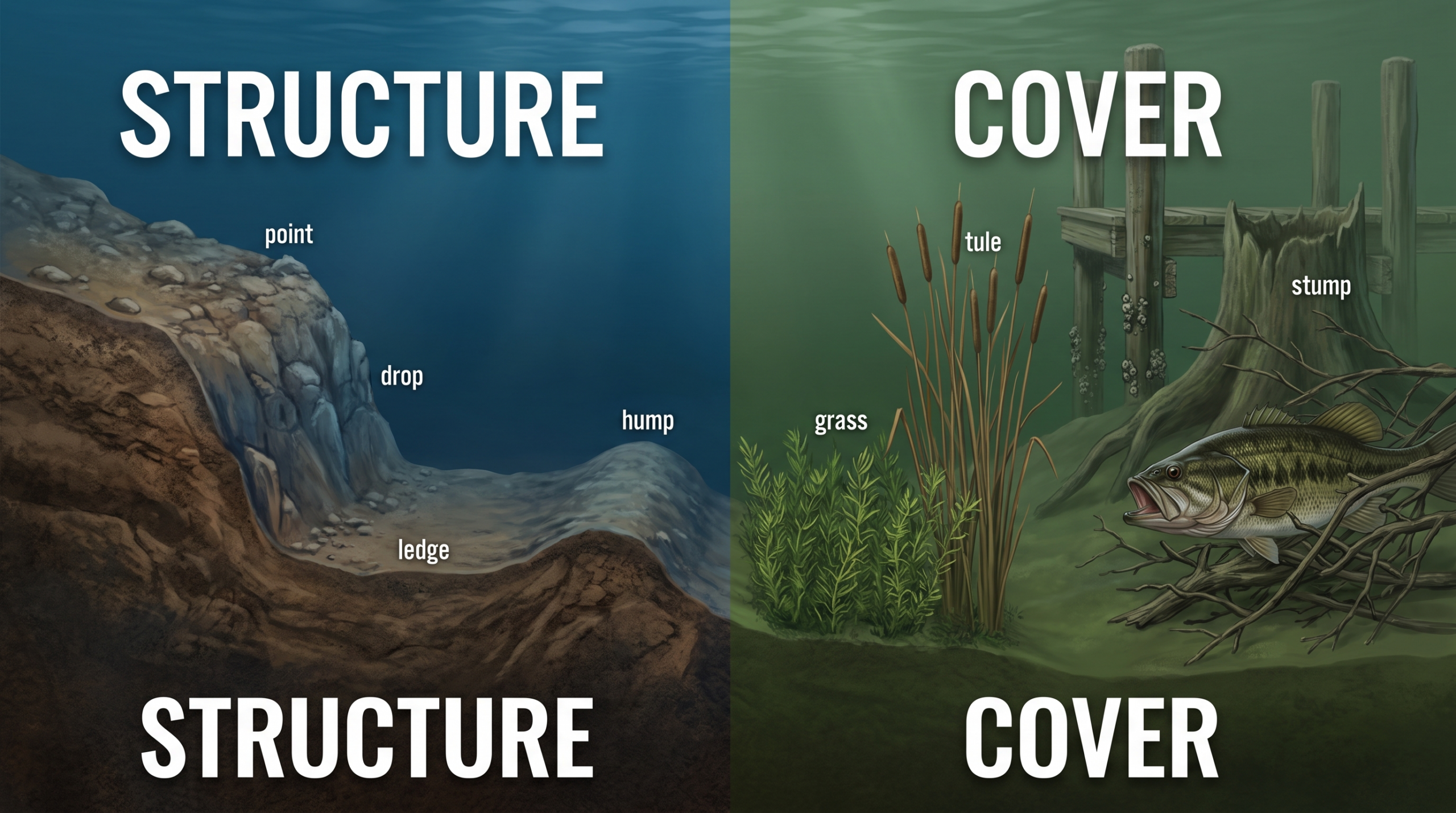
Structure and cover are related, but they are not interchangeable. Structure is the lake’s shape: a point, flat, channel, hump, ledge, drop, or depression. Cover is something on or above that shape: vegetation, tules, a stump, brush, dock posts, shade, or another object that helps a predator hide and prey feel secure.
The best targets often combine both. Imagine a line of outside vegetation growing along a drop, a dock positioned beside a break, or scattered rock on the end of a point. Structure creates the travel route; cover creates the precise cast. When bites come, note both parts. “Fish on grass” is less useful than “fish on the outside grass edge where the flat breaks.”
This distinction also improves boat and bank fishing. From a boat, use mapping or sonar to understand the unseen shape, then cast to the cover on it. From shore, read the visible shoreline for clues: a point continuing underwater, a change in bank steepness, an isolated patch of vegetation, or shade beside a hard edge. Browse the existing fishing spots guide for access ideas without assuming any named area is automatically productive.
Let Forage Refine the Search
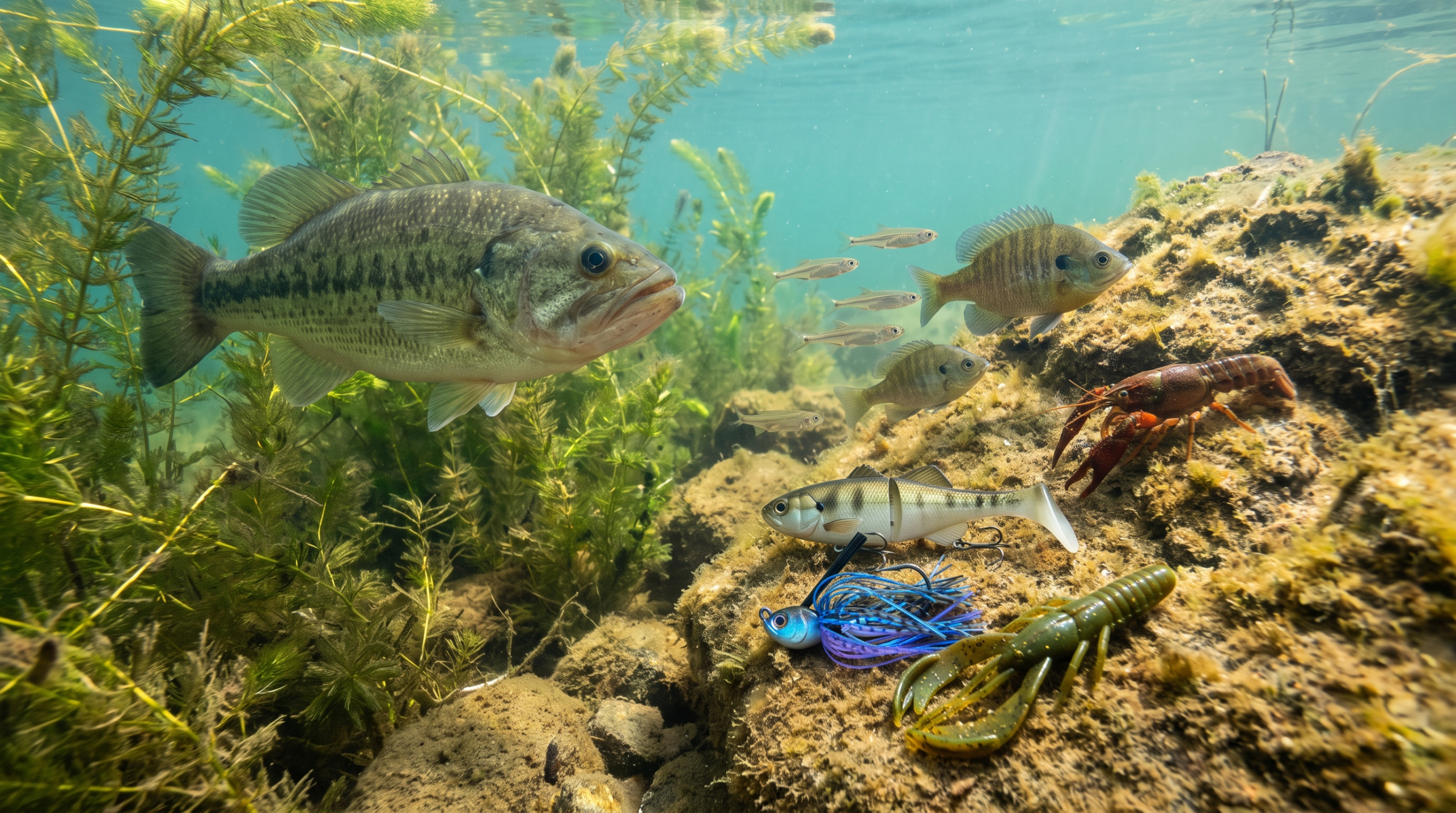
A promising location becomes much stronger when food is present. Watch for small fish flicking at the surface, birds focused on one patch of water, bluegill activity near vegetation, crawfish-colored clues on hard bottom, or repeated marks on electronics. Not every sign identifies the exact species, but activity tells you the food chain is working.
Clear Lake largemouth can use several forage types, including baitfish, sunfish, and crawfish. California anglers also hear about hitch and trout as forage in some waters and situations. Do not turn that into a rule that every bass is eating the same thing. Match what you can observe. A slim baitfish profile, a compact bluegill-like profile, and a bottom-oriented craw presentation give you three practical starting points.
Profile matters more than a perfect paint job. Choose approximate size, shape, depth, and speed before obsessing over a color name. If bait is high and moving, a horizontal swimbait, jerkbait, crankbait, spinnerbait, or vibrating jig may fit. If activity is concentrated on the bottom or beside a target, a jig, Texas rig, drop-shot, or other sinking presentation may be easier to keep in the strike zone. The gear and lure guide can help you build a small, practical selection rather than buying every option.
Treat Vegetation and Moving Water as Positioning Clues
Vegetation can be habitat, shade, an oxygen-producing zone during daylight, and a nursery for prey. It also creates edges: inside lines, outside lines, points, holes, clumps, and transitions between plant types. Bass may use one specific edge rather than the entire field. Make several casts that touch different parts, then repeat the angle and depth that produce a bite.
Healthy-looking vegetation is generally a better starting clue than dying or matted vegetation with poor water exchange, but never assume what is below from the surface alone. Feel the lure, inspect what comes back on the hook, and notice whether bait is present. A clean lure after ticking grass can reveal a useful lane; fouled casts may tell you to change weight, hook style, or angle.
Current means water movement, not only a river-like flow. Wind, inflow, constrictions, and other forces can position food and create a preferred side of cover. Bass often hold where they can feed without fighting the strongest movement—behind an object, along an edge, or in a softer seam. Use this as a question to test, not a claim about current conditions at Clear Lake on any particular day.
Choose Horizontal or Vertical, Then Let the Fish Vote
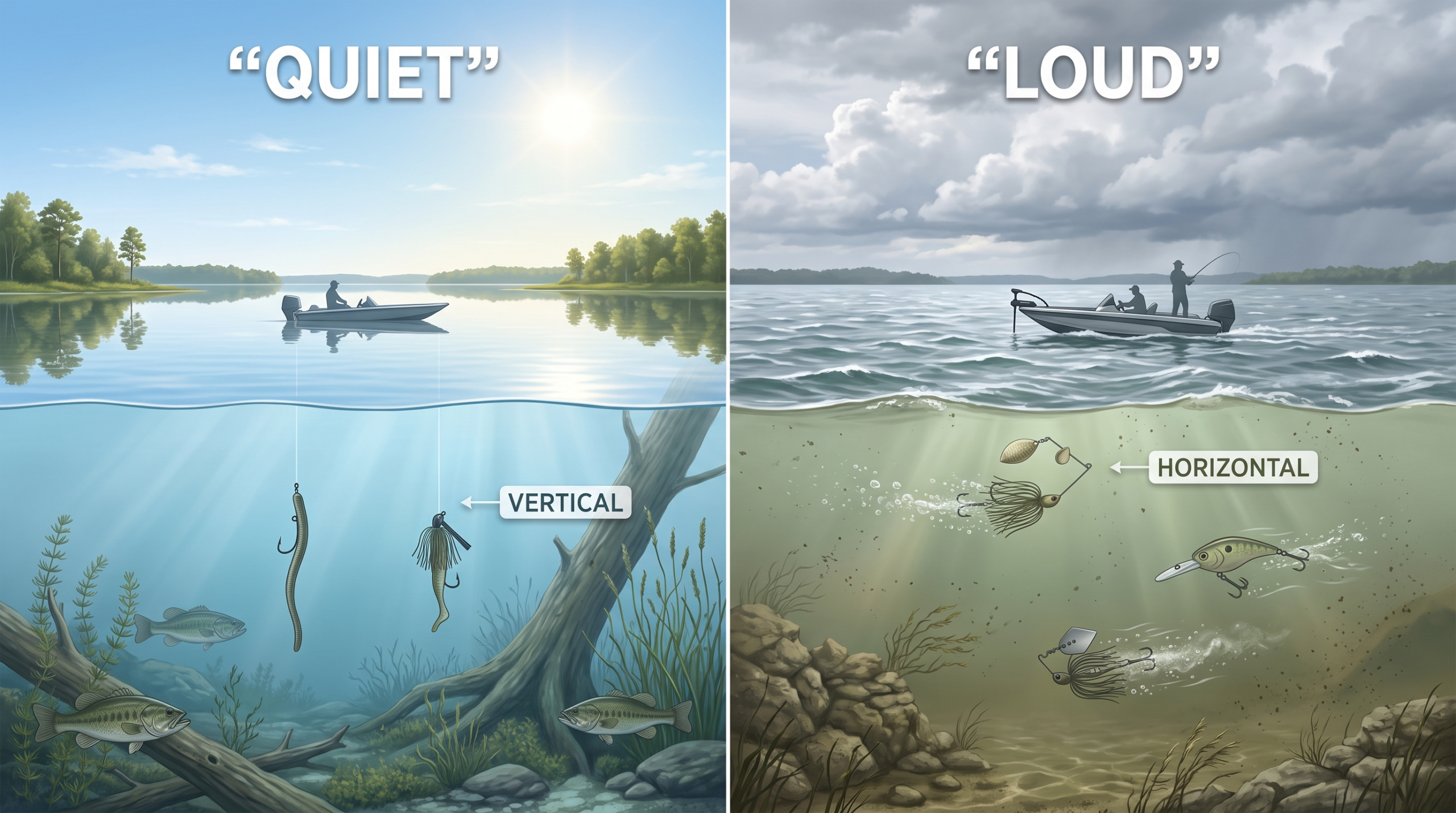
Horizontal lures cover water and travel through the water column: crankbaits, jerkbaits, spinnerbaits, vibrating jigs, topwaters, and many swimbaits. Vertical presentations sink toward a target or bottom and stay in a smaller zone longer: jigs, Texas rigs, drop-shots, shaky heads, and similar finesse options. Some lures can do both, so think about the retrieve rather than the package label.
The video offers a memorable starting idea: “quiet” conditions favor slower or vertical presentations, while “loud” conditions favor moving or horizontal ones. Quiet might mean calm, clear, bright water with little surface disturbance. Loud might mean wind, cloud cover, reduced visibility, or stained water. In louder conditions, vibration, flash, speed, and water displacement can help a bass detect and commit. In quiet conditions, a subtle bait held near cover can look safer.
It is a starting framework, not a guarantee. Begin with one horizontal and one vertical option that match the observed forage. Give each a fair test at the same productive feature. If one gets follows, bumps, or bites, refine speed, depth, and angle before changing everything else.
Choose Color by Visibility and Light
Color decisions become easier when you separate visibility from fashion. In clearer water and stronger light, natural colors can blend with the forage while still looking convincing. In lower visibility—because of stain, depth, shade, cloud cover, or low light—strong contrast can matter more. Dark colors create a silhouette; bright accents can provide a target; white or metallic baitfish tones can add flash.
Start with a forage-based natural color. If fish cannot seem to find it, increase contrast or brightness. If they follow but refuse, reduce flash, choose a more natural tone, or slow the bait. Keep the experiment controlled: change one variable at a time. A color change means little if you also change lure size, depth, speed, and location.
Light can change across the same day and even across one dock or vegetation edge. The sunny side, shaded side, windward edge, and protected pocket may call for different visibility choices. That is why “always throw this color at Clear Lake” is weaker advice than a simple process you can repeat.
A Practical Clear Lake Checklist
- Check the current lake report, weather, access, and applicable regulations before leaving.
- Pick two or three areas that connect seasonal needs: protected water, feeding habitat, and nearby depth or security.
- Identify the structure first, then the exact cover or edge that gives you a casting target.
- Look and listen for forage activity before spending too long in one place.
- Decide whether the water feels quiet or loud based on wind, light, clarity, and surface disturbance.
- Rig one horizontal search bait and one vertical target bait in profiles that fit the observed forage.
- Make controlled changes to angle, depth, speed, and color. Change one variable at a time.
- Record the complete pattern: structure, cover, depth relationship, forage, presentation, and conditions.
- Leave fish and habitat in good shape: handle bass carefully, respect access, and clean up line and trash.
Key Takeaways
- Location and food come before lure brand or color.
- Seasonal movement helps you connect areas; it does not promise fish on a date.
- Structure is the lake’s shape. Cover is the object on it. The overlap is often worth extra casts.
- Vegetation and moving water can reposition bass and forage.
- Use horizontal versus vertical and quiet versus loud as testable starting choices.
- Choose lure color by forage, visibility, and light, then let fish response guide the next change.
Frequently Asked Questions
What should a beginner throw first at Clear Lake?
Carry one moving bait and one bottom or target bait that you can fish confidently. Match their general size and profile to visible forage, then focus on productive cover and depth changes. Confidence comes from making accurate casts and understanding feedback, not from owning a large lure collection.
Does wind always mean I should fish a moving bait?
No. Wind makes conditions “louder” and can improve a horizontal presentation, but fish may still hold tightly to cover or prefer a slower bait. Test both categories in a productive area and let bites decide.
How do I know whether I found structure or cover?
If you are describing the shape of the bottom—point, flat, drop, hump, or channel—you are describing structure. If you are describing an object—grass, tules, wood, rock, dock posts, or shade—you are describing cover. A precise pattern often includes both.
Can I use this guide as a current Clear Lake fishing report?
No. This is an educational framework based partly on a general bass-fishing video. For current information, check the lake report desk and verify conditions yourself when you arrive.
Turn the Framework Into a Day on the Water
The goal is not to predict every bass before the first cast. It is to arrive with a short list of good questions and learn faster from every answer. Pick an area, read its structure and cover, confirm food, choose a presentation that fits the conditions, and keep notes when the fish reveal a pattern.
Source note: This original ClearLakeBassPro.com guide was informed by BassFishingHQ’s “90% of BASS FISHING in 15 Minutes.” It adapts general educational concepts for Clear Lake planning and does not represent the video creator’s claims about current Clear Lake conditions.